Employees don’t hack your company. But they might open the door.
It takes just 21 seconds.
That’s the median time it takes an employee to click a phishing link after opening a malicious email, according to Verizon’s 2025 Data Breach Investigations Report (DBIR). By comparison, the median time to report the email is 28 minutes, giving attackers a significant head start once someone clicks.
That gap explains why phishing continues to be one of the most effective attack techniques available to cybercriminals.
While organizations invest millions in firewalls, endpoint protection, and detection tools, many successful breaches never require attackers to defeat those controls. They simply convince someone to hand over credentials, approve an MFA request, or download malware.
According to Verizon’s latest research, the human element is involved in approximately 60% of all confirmed data breaches, making employee behavior one of the largest cybersecurity attack surfaces every organization has.
The question isn’t whether your organization receives phishing emails.
It’s whether your employees recognize them before it’s too late.
The financial cost of doing nothing
Cybersecurity discussions often focus on technical controls. Executive teams focus on financial risk.
The latest numbers tell an interesting story.
According to IBM’s 2025 Cost of a Data Breach Report, the average global cost of a data breach is now USD $4.44 million. While that’s down from the record USD $4.88 million reported last year, it’s not because cyberattacks are becoming less severe, but because organizations are getting better at detecting and containing them using AI-powered security and automation.
The average breach lifecycle has also fallen to 241 days, the shortest IBM has recorded in nine years. Faster detection directly translates into lower financial losses.
IBM also found that organizations whose internal security teams detected a breach first incurred an average breach cost of USD $4.18 million. When attackers disclosed the breach instead, the average cost increased to USD $5.08 million – nearly USD $900,000 more.
And the financial impact doesn’t end when attackers are removed.
According to IBM:
- 86% of organizations experienced operational disruption after a breach;
- 65% were still recovering after containment;
- among organizations that fully recovered, 76% required more than 100 days to return to normal operations.
Why phishing remains one of the most effective attack vectors
Cybercriminals continue to invest heavily in phishing because it works.
Verizon’s 2025 DBIR found that phishing was present in approximately one-quarter of confirmed breaches, while credential abuse remains one of the most common initial access techniques used by attackers.
Unlike traditional spam campaigns, today’s phishing attacks are:
- AI-assisted;
- highly personalized;
- free of obvious spelling mistakes;
- capable of bypassing traditional email filters;
- designed to imitate executives, vendors, Microsoft 365, DocuSign, payroll systems, and financial institutions.
IBM also found that one in six breaches (16%) involved attackers using AI, most commonly to generate convincing phishing emails (37%) or conduct deepfake impersonation attacks (35%).
As generative AI improves, distinguishing legitimate emails from malicious ones becomes increasingly difficult, even for experienced employees.
Technology alone is no longer enough.
Organizations need employees who recognize suspicious requests before attackers gain access.
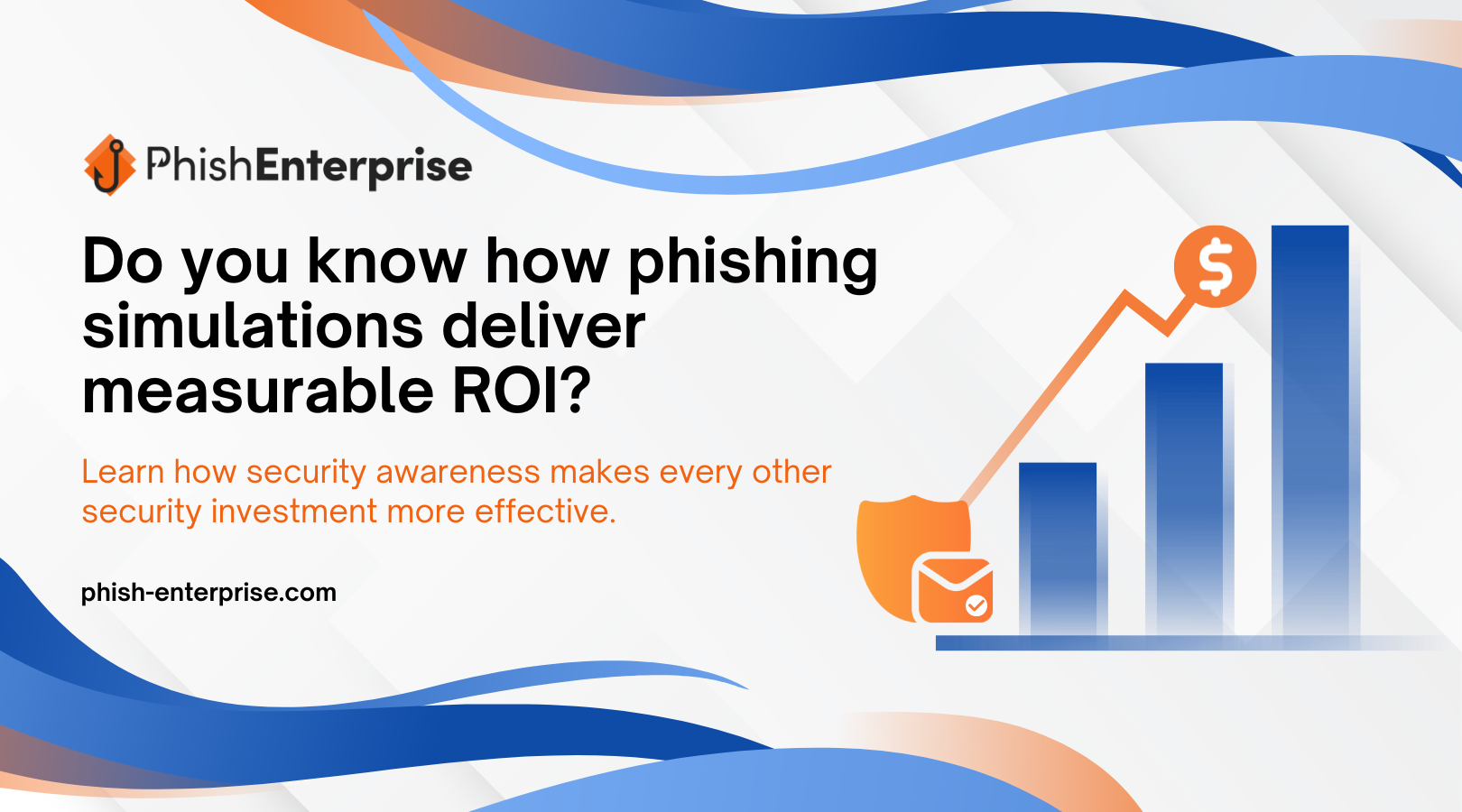
Why phishing simulation delivers measurable ROI
Many organizations still rely on annual security awareness videos to satisfy compliance requirements. Compliance, however, is not the same as risk reduction.
That’s exactly what phishing simulation provides.
Instead of teaching theory, phishing simulations train employees in the environment where attacks actually happen: their inbox.
Over time, organizations can measure improvements in:
- click rates;
- credential submission rates;
- reporting rates;
- high-risk user groups;
- department-level risk trends;
- overall human risk posture.
This transforms security awareness from a compliance exercise into a measurable security control.
The ROI of phishing simulations is easier to prove than most organizations think
Imagine a company with 1,000 employees.
Even with modern email filtering in place, phishing emails still reach employee inboxes every day.
If internal phishing simulations show a 20% click rate, reducing that figure to 5% through continuous simulation and targeted coaching cuts employee susceptibility by approximately 75%.
Now compare that improvement against the USD $4.44 million average cost of a breach.
The economics become obvious.
The cost of an annual phishing simulation platform is only a fraction of the financial impact of a single successful incident.
Preventing one credential compromise, ransomware infection, or business email compromise over several years can generate a return that far exceeds the cost of the program.
IBM’s research reinforces this broader principle. Organizations that extensively used AI and automation in their security operations reduced average breach costs.
Phishing simulation complements these investments by reducing the likelihood that attackers gain their initial foothold in the first place.
Security awareness doesn’t replace technology.
It makes every other security investment more effective.
Ready to see what it would cost?
Ask us for a personalized quote and learn how Phish Enterprise can help reduce your organization’s phishing risk with realistic phishing simulations and ongoing security awareness training.
The metrics your CFO actually cares about
Security leaders often frame awareness training as a compliance initiative.
Executives approve budgets based on business outcomes.
A strong business case should answer four questions:
➤ What is our current employee phishing risk?
➤ How much would a successful breach cost us?
➤ How much can we realistically reduce that risk?
➤ How much does that reduction cost compared to the financial impact of a breach?
When presented this way, phishing simulation becomes far easier to justify because it directly addresses enterprise risk rather than simply fulfilling regulatory requirements.
Start with your baseline
Most organizations don’t actually know how vulnerable their employees are.
Without measuring phishing susceptibility, it’s impossible to build a credible ROI case or determine whether security awareness efforts are working.
A baseline phishing assessment provides objective answers to questions such as:
➤ Which departments are most vulnerable?
➤ Which users require additional coaching?
➤ What is your current click rate?
➤ How frequently are suspicious emails being reported?
➤ How does your organization compare to industry benchmarks?
Once you have those numbers, you can build a business case based on your organization’s actual risk – not generic industry averages.
Reduce human risk before attackers exploit it
Cybercriminals are getting faster, more convincing, and increasingly powered by AI.
Your employees remain one of your greatest assets, but they’re also one of your largest attack surfaces.
Continuous phishing simulation transforms security awareness from an annual compliance exercise into an ongoing risk reduction program that delivers measurable improvements over time.
Ready to reduce your phishing risk?
Contact us to learn how Phish Enterprise can help your organization build a stronger human firewall.